In this guide · 14 parts
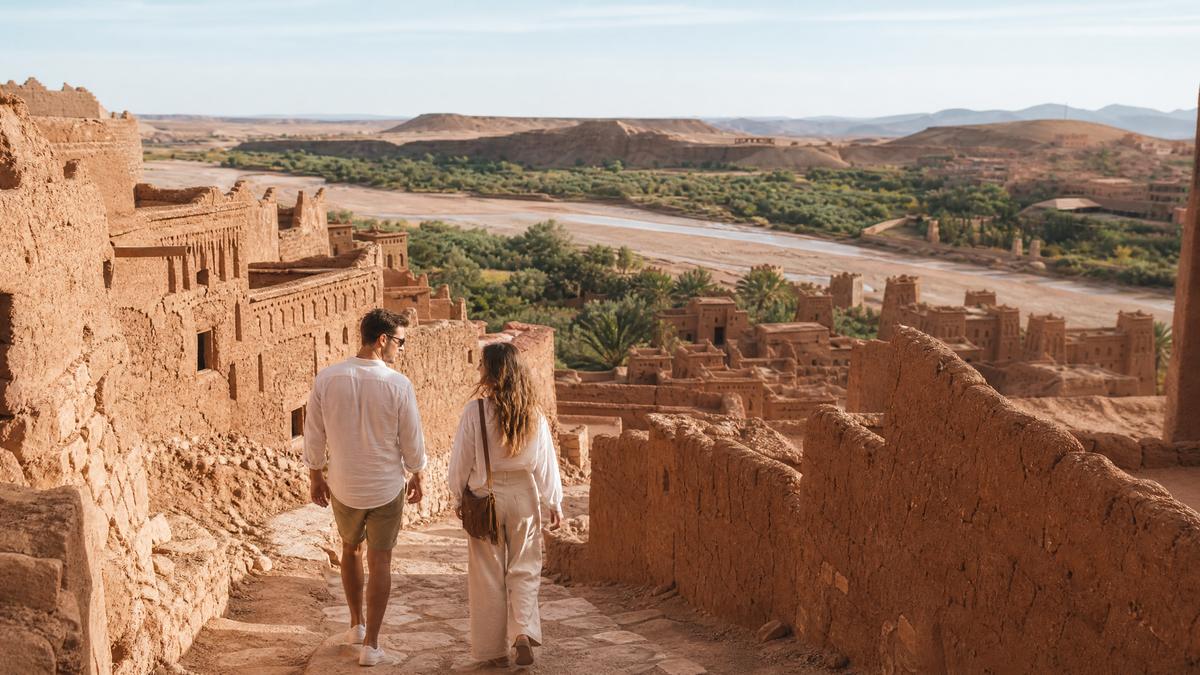
Aït Ben Haddou is a ksar, a fortified village of earth, on the old caravan route between the Sahara and Marrakech, listed as UNESCO World Heritage in 1987. Built in pisé on a hill above the Ounila river, it has been the setting of many films, including Lawrence of Arabia and Gladiator.
A village on the caravan road
For centuries, caravans carried salt, gold, dates and slaves between the Sahara and the cities of the north. One of their roads followed the valley of the Ounila, over the High Atlas towards Marrakech. Villages like Aït Ben Haddou grew along the route, offering water, shelter and protection to the caravans, and taxing their passage.
A ksar (plural ksour) is a village enclosed by walls, with houses packed closely together, towers at the corners, and a collective granary, the agadir, at the top, where families stored their grain in times of trouble.
Built of earth and straw
Almost everything in Aït Ben Haddou is made of pisé: earth mixed with straw and water, rammed into wooden frames to build thick walls that keep the houses cool in summer and warm in winter. Towers are decorated with geometric patterns carved into the earth near the top.
Earthen buildings are beautiful and fragile. Heavy rain washes away the surfaces, and walls must be repaired regularly with the same materials. Much of the restoration work you see is done by families and local craftsmen using traditional methods.
UNESCO World Heritage since 1987
UNESCO listed the ksar in 1987 as a striking example of the earthen architecture of southern Morocco. The oldest buildings visible today are thought to date from around the 17th century, on a site that is much older.
The films
The light, the colours and the landscape made Aït Ben Haddou and nearby Ouarzazate a favourite of filmmakers. Among the productions shot here or nearby are Lawrence of Arabia, Jesus of Nazareth, The Mummy, Gladiator, Kingdom of Heaven and scenes of Game of Thrones. Some of the gates and walls you walk past have appeared on screen more than once, lightly transformed by film crews.
| Film or series | Year |
|---|---|
| Lawrence of Arabia | 1962 |
| Jesus of Nazareth | 1977 |
| The Mummy | 1999 |
| Gladiator | 2000 |
| Kingdom of Heaven | 2005 |
| Game of Thrones | 2010s |
Who lives there today
Most families moved across the river to the new village, where there is electricity, running water and road access. A few families still live inside the ksar, and many houses have become small shops, galleries and cafés. Please respect private homes: if a door is closed, it is someone's house.
How to visit
Cross the river on the footbridge (or by the stepping stones when the water is low), and walk up through the lanes to the granary at the top. The climb takes about twenty minutes and the view stretches over the valley towards the desert. The ksar itself is free to enter; some houses ask a small fee to visit inside. A local guide is optional and brings the history to life.
When to go
Aït Ben Haddou is beautiful all day, but the late afternoon is magical: the walls glow orange and the shadows soften. Midday in summer is hot; bring water and a hat.
How to get there from Marrakech
The ksar is about 190 km from Marrakech, around four hours over the Tizi n'Tichka pass, and 30 minutes from Ouarzazate. You can visit it on a day trip from Marrakech, or on the first day of any desert tour to Merzouga, Zagora or Erg Chigaga.
What to see inside the ksar
Walking up from the river, you pass through a covered gateway into lanes that twist between high earthen walls. Look up at the towers of the old family kasbahs, decorated with carved geometric motifs, and at the small windows placed high to keep out the heat. Halfway up, several houses have been turned into galleries where local artists paint with saffron, tea and indigo, then heat the paper to reveal the image. At the top, the ruins of the agadir, the collective granary, look over the whole valley.
Respectful visiting
Aït Ben Haddou is a living place, not a film set. Ask before photographing people, keep to the paths, do not climb on fragile walls, and if you buy a souvenir, buy it from the families who live and work in the ksar: it helps keep the village alive and the walls repaired.
Combine it with
On a day trip, Aït Ben Haddou pairs naturally with the Tizi n'Tichka pass and, if time allows, the kasbahs of Ouarzazate. On a desert tour, it is the first great stop of day one, before the Road of a Thousand Kasbahs and the Valley of Roses.
Where to eat
Several terraces facing the ksar serve tagines and salads with a view of the whole village; lunch here is one of the classic moments of any trip to the south.
Questions
When was Aït Ben Haddou built?
The oldest buildings visible today are thought to date from around the 17th century, on a much older site on the caravan route.
Do people still live in Aït Ben Haddou?
A few families; most moved to the new village across the river.
Is Aït Ben Haddou free to visit?
The ksar is free to walk through; some houses ask a small fee to visit inside.
What films were shot at Aït Ben Haddou?
Among others Lawrence of Arabia, Gladiator, The Mummy and scenes of Game of Thrones.
How far is Aït Ben Haddou from Marrakech?
About 190 km, around four hours over the Tizi n'Tichka pass.