
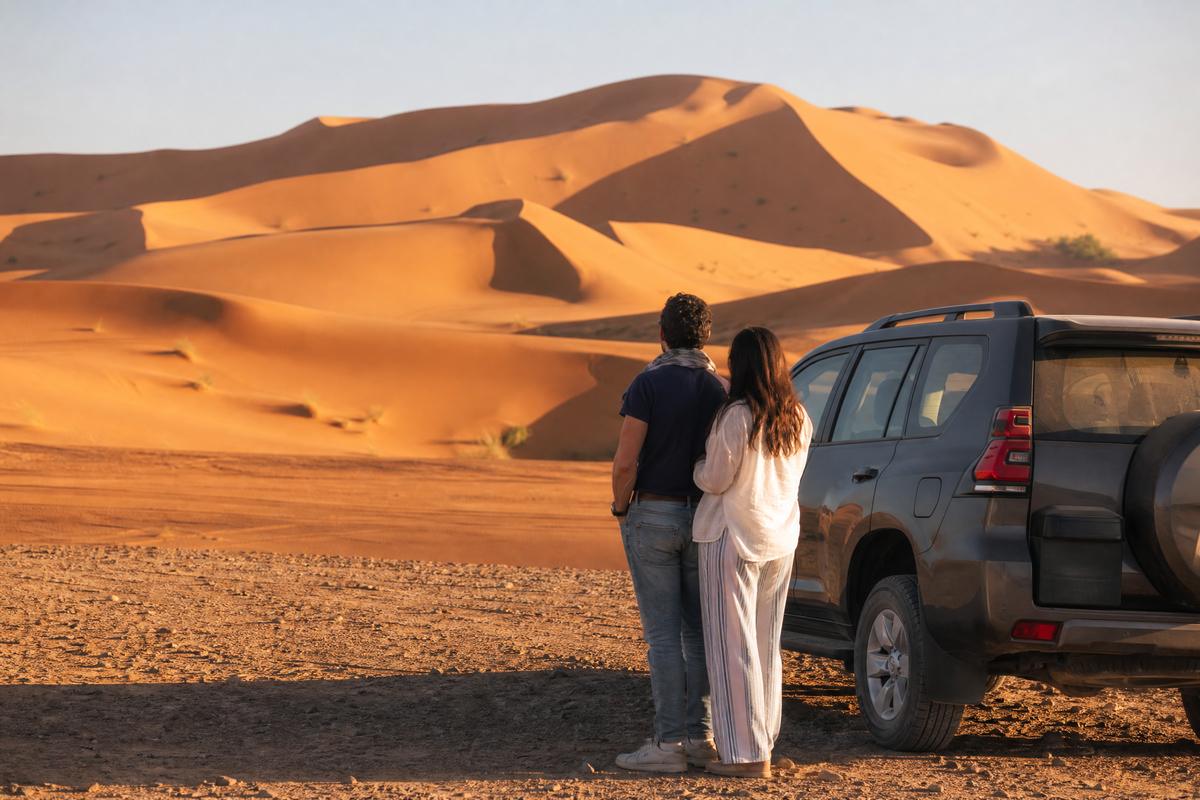
16:30 — the camels
You arrive at the edge of Erg Chebbi mid-afternoon. Your big bag stays locked in the vehicle; a small bag goes on the camel or with you. The camels kneel, you climb on, they stand up in two lurches (hold the bar), and the caravan walks into the dunes at the speed of a slow walk for about an hour. It is comfortable for most people, less so for anyone with a bad back or hips — tell us and a 4x4 takes you in instead. Children ride with an adult or alone depending on age.
18:00 — arrival and sunset
The camp is in a hollow between dunes. You get your tent, drop the bag, and go straight up the dune behind the camp — ten to twenty minutes of soft sand — for the sunset. This is the photograph. Come down in the last light; tea is waiting.
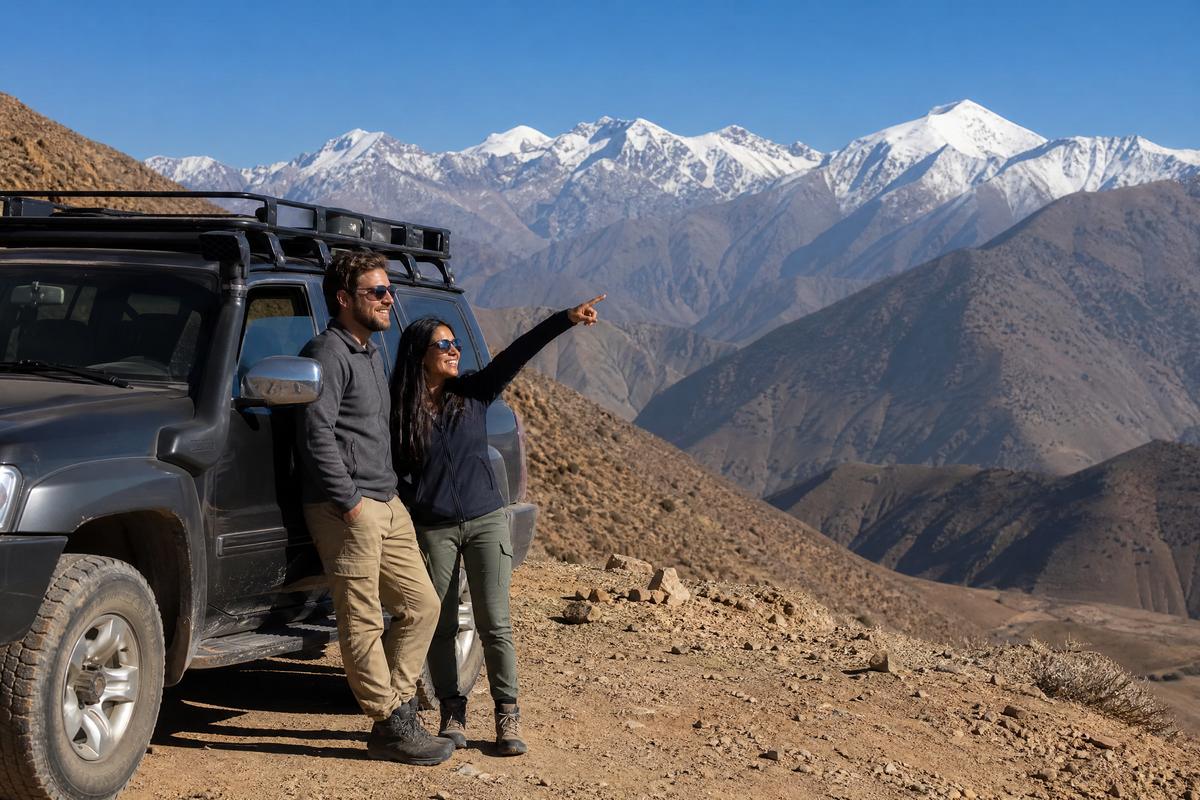
19:30 — dinner
In the main tent or, on calm nights, outside: soup (harira), a tagine (chicken with olives, vegetable for vegetarians, tell us in advance), bread, fruit, mint tea. Simple and good. Water is included; other drinks depend on the camp.
21:00 — fire and music
The staff light a fire in front of the camp and play — drums, sometimes a guembri, Gnaoua rhythms. You are invited to try. It lasts as long as people want it to.
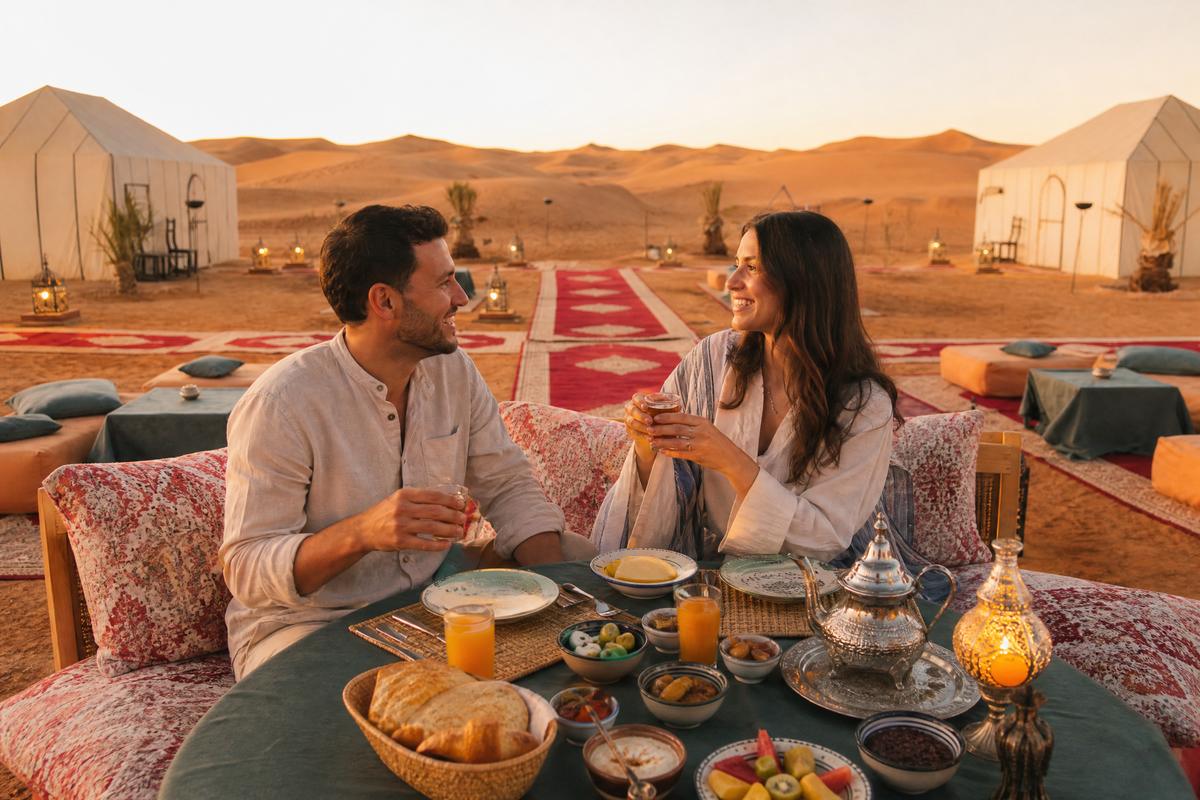
23:00 — the sky
Walk fifty metres from the fire and look up. No town for kilometres, so on a moonless night the Milky Way is a band across the sky. On a full-moon night the dunes glow and the stars fade — beautiful in a different way. Check the moon phase when choosing dates if this matters to you.
03:00 — the cold
The desert loses its heat fast. From November to March the temperature in camp drops to 0–5 °C; there are thick blankets — several — and the tents are closed, but you will notice it. A warm layer to sleep in, socks, a hat if you feel the cold. In summer the opposite: warm nights, blankets pushed off.
06:30 — sunrise
Someone wakes you in the dark. You climb the dune again — harder in the cold, worth it — and watch colour come back into the sand. Breakfast at the camp afterwards: bread, jam, eggs, tea, coffee.
08:00 — back
Camels (or the 4x4) back to the vehicle; the day's driving begins.
The bathroom question
The one everybody asks and nobody answers on the brochure. In a standard camp the bathrooms are in a separate block: flush toilets, hot showers (solar or gas, so short and warm rather than long and hot), a walk across the sand with a torch. In a luxury camp the bathroom is inside your tent, behind a canvas wall: your own toilet, your own shower, the same warm-not-hot water. In an Elite camp the bathroom is a proper room. On our shared tours the standard camp is included and luxury is an option at booking; on private tours the luxury camp is included. → Desert Luxury Camp — standard tent · Sahara Stars Camp — luxury tent
Standard, luxury, Elite
| Standard | Luxury | Elite | |
|---|---|---|---|
| Tent | Private, real bed, blankets | Private, better bed, lamps, terrace | Room-sized, furniture, terrace |
| Bathroom | Shared block | In your tent | In your tent, proper room |
| Camp size | Larger | Smaller | Small, remote |
| Dinner | Set menu, main tent | Set menu, lounge tent or outside | Chef, private dinner on a dune on request |
| Included on | Shared tours | Private tours; option on shared | Elite journeys |
| Read more | Standard camp | What a luxury camp really includes | Elite camps |
Who it suits, who it doesn't
It suits almost everyone who arrives knowing what it is: couples, families with children over five, friends, solo travellers, people in their seventies who take the 4x4. It does not suit anyone who needs a real hotel every night, who cannot manage cold, or who expected Wi-Fi. If that is you, the four-day tours add a lodge night at the edge of the dunes with a pool — do the camp for one night and the lodge for the next.
 Journal